The New Craftsman
On the evolving hand, the changing meaning of craft, and a new generation of makers
By Khushali Chawda
The world seems to be moving towards a new wave of craftspeople.
For a long time, our conversations around craft have centred on preservation. On techniques disappearing, skills being lost, and generations of knowledge at risk of fading away. Preserving these traditions is important. They hold histories, cultures and ways of understanding material that cannot simply be recreated once they are gone.
But preservation is only one part of the conversation.
Alongside the craftspeople carrying inherited traditions forward, there is another movement taking shape: new people are choosing to become craftspeople.
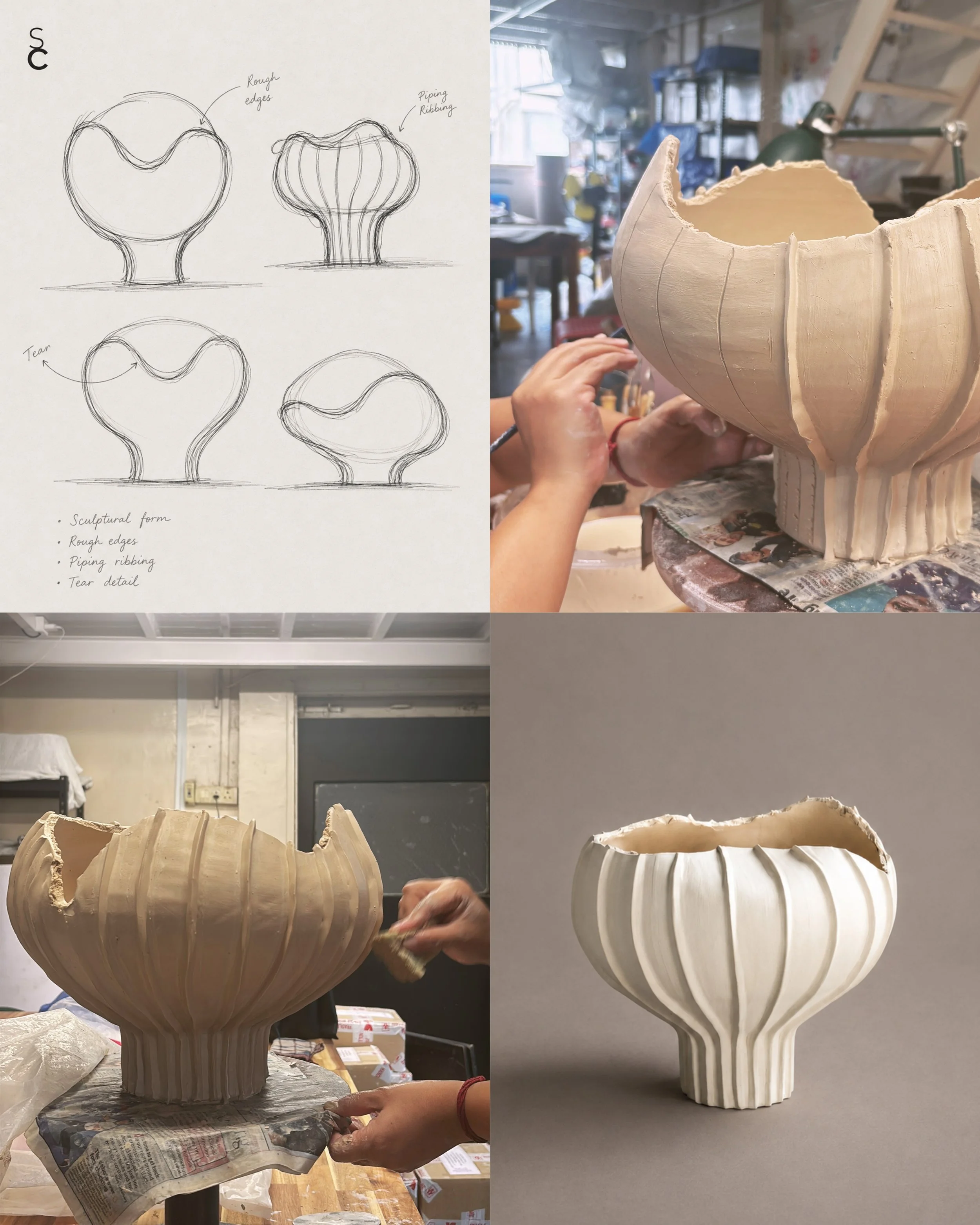
Process from Sketch to Product
They may not have inherited a craft through generations. They may have come to making through architecture, art, product design, fashion or engineering. Their education may have begun on a computer rather than in a workshop. Yet increasingly, there seems to be a desire to return to the hand—to touch material, to understand how something is made, and to experience the repetition, resistance and unpredictability that making demands.
Perhaps craft is not only something we inherit. Perhaps it is something we can choose to embody.
In The Craftsman, Richard Sennett describes craftsmanship through a fundamental human impulse: the desire to do something well for its own sake. Seen this way, craftsmanship is not restricted to a particular material, technique or lineage. It is a relationship with one's work—built through attention, repetition, patience and care.
The hand learns by doing.
A material resists. The maker responds. Something fails. The process changes. The same gesture is performed again and again, and yet the result is never entirely the same.
This is what makes craft feel particularly relevant today.
We live in a time increasingly defined by speed, automation and seamlessness. Objects can be designed, rendered, manufactured and delivered with extraordinary precision. Yet alongside this acceleration, there seems to be a growing attraction towards things that reveal how they came into being.
A fingerprint.
A carving.
A hammer mark.
An uneven edge.
A glaze that behaves differently from one firing to another.
These are not simply imperfections. They are records of a process.
The contemporary craftsperson does not necessarily reject technology either. The hand and the machine no longer need to sit on opposite sides of the conversation.
A form might begin as a sketch, move into a digital model, become a prototype through a machine and eventually return to the hand. Precision and irregularity can exist within the same object. Industrial processes can sit alongside carving, casting, hammering and glazing.
Perhaps this intersection is where a new language of craft is emerging.
At Cumulus, this relationship between control and unpredictability has always interested us. We are drawn to what happens when materials with different histories and processes are brought together—when the precision of one material meets the irregularity of another, or when something carefully designed is allowed to retain the evidence of its making.
The object that emerges carries both intention and accident.
And perhaps that is what separates an object that has merely been produced from one that feels as though it has been made.
Craft does not need to remain frozen in the moment from which it originated in order to survive. A living craft changes. New tools enter the workshop. New materials appear. New hands interpret old gestures differently. New practitioners arrive without generations of inherited knowledge and begin, slowly, to develop knowledge of their own.
There is enormous value in protecting the crafts that have been handed down to us.
But there is also value in creating the conditions for craftsmanship to begin again.
For people to become curious about material.
To spend time learning with their hands.
To make mistakes.
To repeat.
To develop their own processes.
And eventually, perhaps, to pass those processes on.
The future of craft may therefore lie in two simultaneous movements: preserving the knowledge of the hands that came before us, while making space for new hands to discover what they can become.
Craft is not only our inheritance.
It is still being written.
